The Empty Stocking Isn’t About the Stocking
Why moms are furious, exhausted, and quietly heartbroken—and what this moment actually reveals about modern marriage
If you spent any time online after Christmas this year, you probably saw it.
Threads. Instagram. TikTok. Screenshots shared with equal parts rage and resignation.
Moms waking up Christmas morning to an empty stocking.
Not metaphorically. Literally empty.
And the internet response came fast and loud:
“Leave him.”
“The bar is in hell.”
“This is why women are done.”
But here’s the uncomfortable truth no one wants to slow down enough to say:
The stocking isn’t the real issue.
It’s the symbol.
And the reason this hit such a nerve is because it exposed something much bigger than candy and chapstick.

Why This Became a Cultural Flashpoint (Again)
This isn’t new.
But this year, it landed differently.
Because moms are tired in a way that doesn’t resolve with a bubble bath.
Because mental load is finally being named, not just endured.
Because women are done pretending disappointment doesn’t mean something.
One post that made the rounds captured it perfectly:
“For my stocking this year, my husband went into my makeup bag and bought refills of the items I was almost out of—using coupons and my Ulta number so I’d get points. That wasn’t just thoughtful. That was mental load relief.”
That’s not about gifts.
That’s about being seen.
Another woman shared:

Same holiday.
Very different message from two different partners.
And then there were the posts that cracked something open:
“I bought my own stocking stuffers. Because who else would?”
“My kids opened gifts from both of us. He opened his. I sat there empty-handed.”
“It was never about the gifts. It was about being invisible.”
That’s the moment this stops being petty.

The Stocking Is a Test, But Not the One People Think
There’s a reason women keep saying, “It wasn’t about the stocking.”
Because what they’re actually asking is:
Do you notice what I carry?
Do you see what I do?
Do you think about me when I’m not reminding you?
And for many moms, the stocking became a quiet test they didn’t even realize they were giving.
Not a test of generosity.
A test of awareness.
And when it failed, the conclusion came fast:
If he didn’t think of this, what else am I invisible in?
That’s why the emotional reaction feels outsized.
Because the meaning is layered.
“But I Didn’t Know I Was Supposed To” Isn’t the Defense Men Think It Is
This is where things get sticky.
Some men genuinely didn’t grow up seeing dads fill mom’s stocking.
Some families never did adult stockings before kids.
Some couples never talked about it.
All of that can be true.
And still…
As writer and mental-load educator Paige Turner put it:
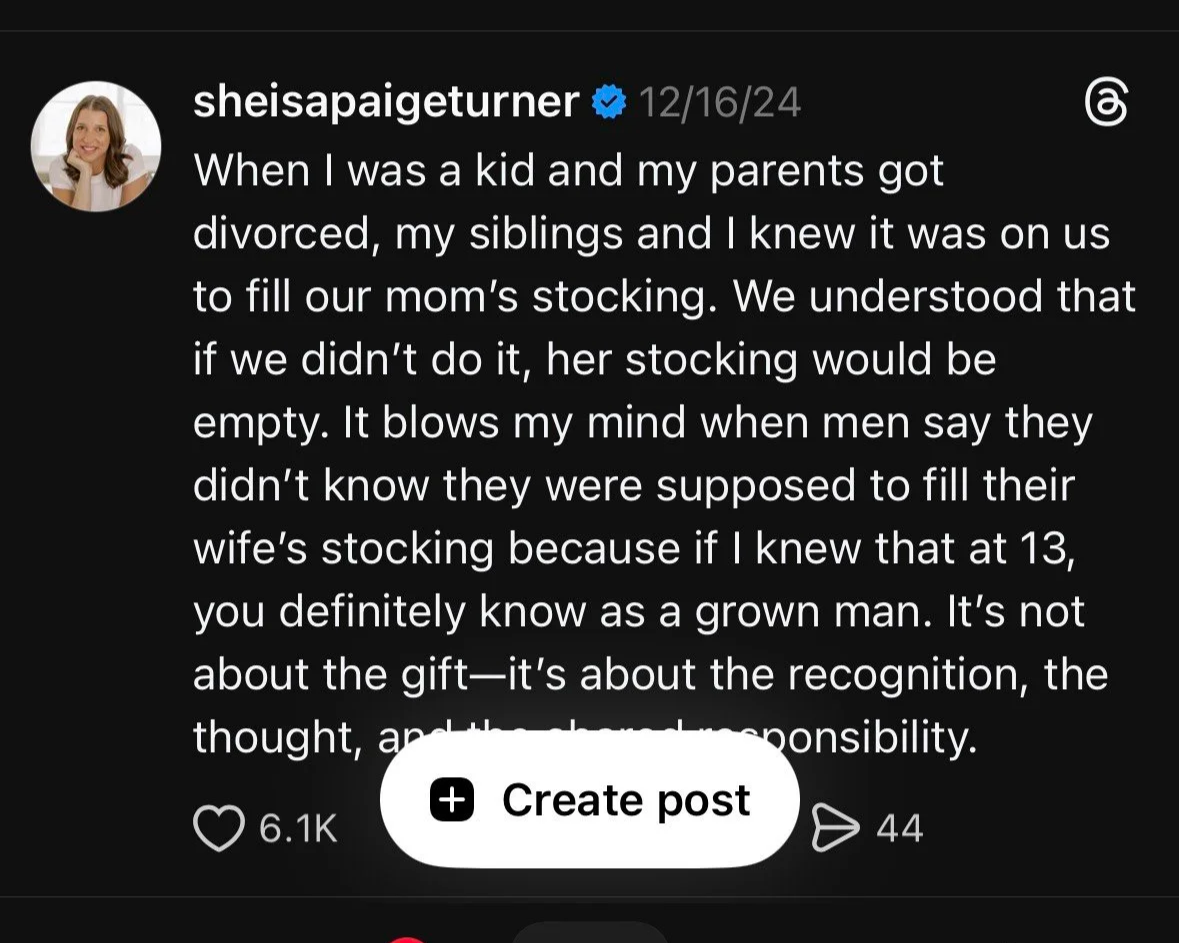
That’s the part women can’t unsee.
Because once you notice, “Wait—my kids are watching this,” it shifts from disappointment to something closer to grief.
Why “Just Leave Him” Is a Lazy Take
Yes, some men are willfully disengaged.
Yes, some patterns don’t change.
Yes, some women have begged for years and are done.
But the idea that an empty stocking equals an irredeemable partner ignores reality.
It ignores:
How deeply inherited family patterns run
How little modern marriage has been modeled well
How often expectations go unspoken until they explode
There’s a difference between:
A man who doesn’t care
andA man who has never been taught to look for invisible labor
And those are not the same marriage.
The danger of the internet’s hot takes is that they collapse the entire spectrum into one conclusion.
And real families live in the nuance.
Click the image to instantly download the PDF and address your feeling with confidence
The Part No One Wants to Admit: Sometimes Women Carry It All… Then Get Furious About Carrying It All
This is uncomfortable, but it matters.
Some women take control of holidays, traditions, logistics, and emotional tone.
They refuse help.
They micromanage.
They “just do it themselves.”
And then feel crushed when no one steps in.
That doesn’t mean the disappointment isn’t valid. It means the system is broken on both sides.
Even in those dynamics, though, one thing still holds:
Your partner should have put something in your stocking.
Because partnership isn’t about perfection, it’s about participation.
Why Men Aren’t “Just Noticing” These Things
This isn’t about intelligence.
It’s about conditioning.
For generations:
Women managed the home.
Men provided income.
Emotional and relational labor was invisible by design.
Now the conditions have changed.
Dual-income households.
Exhausted parents.
Little external support.
And families are being asked to function as tight, regulated teams without the village that used to hold them.
Many men genuinely want to do better—but they don’t know where to start.
And hearing it only from their partner often lands as criticism, not coaching.
That’s why this matters:
Men don’t just need reminders.
They need models.
And they need to hear it from other men.
The Real Fix Isn’t Better Stockings. It’s Better Teamwork.
Here’s what actually shifted things in our own family—and for the couples we work with:
1. Ownership of categories, not tasks
Not “grab these three things,” but “you own stockings.”
2. Fewer traditions, more presence
If it doesn’t pay out emotionally, let it go.
3. Explicit expectations
What mattered to you this year?
What felt disappointing?
What do you want next year to look like?
4. Repair instead of resentment
Disappointment doesn’t have to become a character judgment.

The Question That Matters More Than the Stocking
Instead of asking, “Did he fail?”
Ask this:
Is this person willing to grow with me?
Not perfectly.
Not immediately.
But genuinely.
Because long-term relationships aren’t built on flawless holidays.
They’re built on repair, awareness, and the willingness to change patterns that no longer serve their purpose.
Sometimes the stocking is a wake-up call.
Sometimes it’s a red flag.
And sometimes it’s an invitation to build something better than what either of you inherited.
Ready to explore what building could look like for you and your partner? Check out our current offerings and schedule a consultation call with us to learn more.
