The Invisible Load: What It Is, Why It Matters, and How to Share It Before It Breaks You
When we became parents, we thought we were ready. We were solid teammates, good communicators, and partners in life. But then something crept in that we didn’t see coming: the invisible load.
It showed up slowly, in things like tracking nap windows, remembering to size up diapers, or mentally mapping out when the next pediatrician visit was due. And suddenly, instead of feeling like teammates, we were both exhausted, frustrated, and wondering why it felt like the weight of parenthood was falling so unevenly.
Sound familiar? You’re not alone. (Book a free connection call with us here to tell us more about what has shocked you about early parenthood and where you want to be)
What Is the Invisible Load?
The invisible load is the mental and emotional labor of running a household and raising a family. It’s all the tabs constantly open in your brain.
Mike puts it this way: “It’s like when your computer slows down because you’ve got 27 tabs open, pushing it to the limit and just hoping it doesn’t crash before you finish what you’re doing. That’s what the mental load feels like.”

If your brain feels like this, you might be suffering from the invisible load.
In early parenthood, the invisible load can look like:
Remembering nap windows and feeding logs
Coordinating pumping schedules, childcare, and visitor boundaries
Grocery planning and keeping track of finances
Juggling pediatrician appointments, vaccines, and developmental milestones
Making sure there’s a bigger size of diapers in the closet
Switching clothes out of closets because kids grow out of them so fast
Chelsea remembers word-vomiting this endless list to Mike one day and watching his face: “It blew me away how much I was carrying that he didn’t even see. And then to hear him say, ‘I could never keep track of all that’—I remember feeling frustrated because in my head, I didn’t have a choice.”
That’s the weight of the invisible load.
Why Does It Fall Unequally?
Even couples with good intentions find themselves in unequal patterns. Part of it is gender conditioning—women are raised to anticipate, nurture, and remember. Part of it is cultural scripts—we still glorify the “busy, overwhelmed mom” and judge her when things slip through the cracks.
Mike admits he assumed Chelsea would be the “expert” because she carried and birthed the baby: “I thought this was her field of expertise. If she needed me, she’d call me in.”
And Chelsea remembers reinforcing that at times: “I know I said things like ‘mother’s intuition’ after our first. But what I didn’t see was how much pressure I was piling on myself because I thought it all fell on me.”
Research shows this isn’t just personal, it’s systemic. Sociologist Allison Daminger found that women overwhelmingly carry the cognitive labor in households, even when both parents work. And the APA has reported rising parental burnout, especially for moms, with the mental load as a key driver.
Unequal doesn’t always mean intentional, but without intentional change, it becomes the default.
How It Impacts Relationships
Left unspoken, the invisible load erodes connection.
It sounds like:
“I do everything.”
“You don’t even notice what I carry.”
Mike describes it like attacking your battle buddy: “When you’re throwing darts at the only teammate you’ve got, everyone loses.”
And it creates a toxic cycle—one partner feels unappreciated, the other feels attacked, and both stop seeing each other as teammates.
How to Share the Invisible Load
Here’s the framework we use with couples (and in our own marriage): See it. Say it. Slay it.
1. SEE IT
You can’t change what you don’t see. Ask:
“What are you tracking right now that I might not see?”
Chelsea remembers when Mike first asked her this: “It stopped me in my tracks because even I hadn’t realized how much I was holding until I started saying it out loud.”
Try a mental load brain dump. Each of you spends 5 minutes writing down every task, worry, and responsibility in your head.
2. SAY IT
Bring it into the light.
Chelsea: “The first few times I rattled off my list, Mike felt defensive—like he needed to prove he was doing enough. We had to learn that this wasn’t about comparing lists. It was about putting everything in one big pool and deciding how to tackle it together.”
Use simple scripts:
“Here’s something I’ve been carrying that I didn’t even realize until now.”
“Can I share the list of what’s swirling in my head right now?”
3. SLAY IT
Redistribute the load intentionally. Not 50/50, but fair.
Some tasks make sense for one partner based on strengths or season. Others are shared. And some? They’re parked for later because they simply don’t matter right now.
This is where permission comes in.
Chelsea: “I needed someone to remind me I didn’t have to do it all. My babies have never thanked me for those Pinterest-worthy baby-led weaning plates. Looking back, I could’ve saved myself the stress.”
Ask yourself:
Is this truly valuable for our family?
Or is it pressure from society, Instagram, or in-laws?
Mike adds: “The goal isn’t perfection—it’s teamwork. The load isn’t just chores, it’s the emotional climate of your home.”
A Quick Example
Take meal planning. Instead of one person holding all the steps, you can split:
Partner A makes the meal plan and grocery list.
Partner B picks up groceries and preps dinner.
Or you divide by meals: one person owns breakfast, the other dinner.
Same with baby gear: One person researches car seats and strollers, the other manages pediatrician appointments and tracking feeds.
Without intention, these almost always fall to mom. But with intention, you build a system that reflects both of your strengths.

One example of the mental load I remember distinctly was feeding choices, specifically baby-led weaning or traditional baby food. This felt especially taxing because our families didn’t understand the concept of BLW, and so we felt we had to research more to justify our choices.
Why This Matters Beyond Tasks
The invisible load isn’t just about logistics. It’s about the atmosphere your baby grows up in.
Chelsea puts it this way: “Your baby doesn’t just grow in your arms—they grow in the emotional atmosphere between you.”
When one partner is drowning and the other feels shut out, the atmosphere is strained. But when both are aware, contributing, and connected, the whole family feels steadier.
Try This Today
Spend 3–5 minutes writing down your mental tabs.
Share your lists without defensiveness.
Choose one thing you’ll fully own this week so your partner doesn’t have to think about it.
👉 Download our free Invisible Load Brain Dump Template to make it easier.
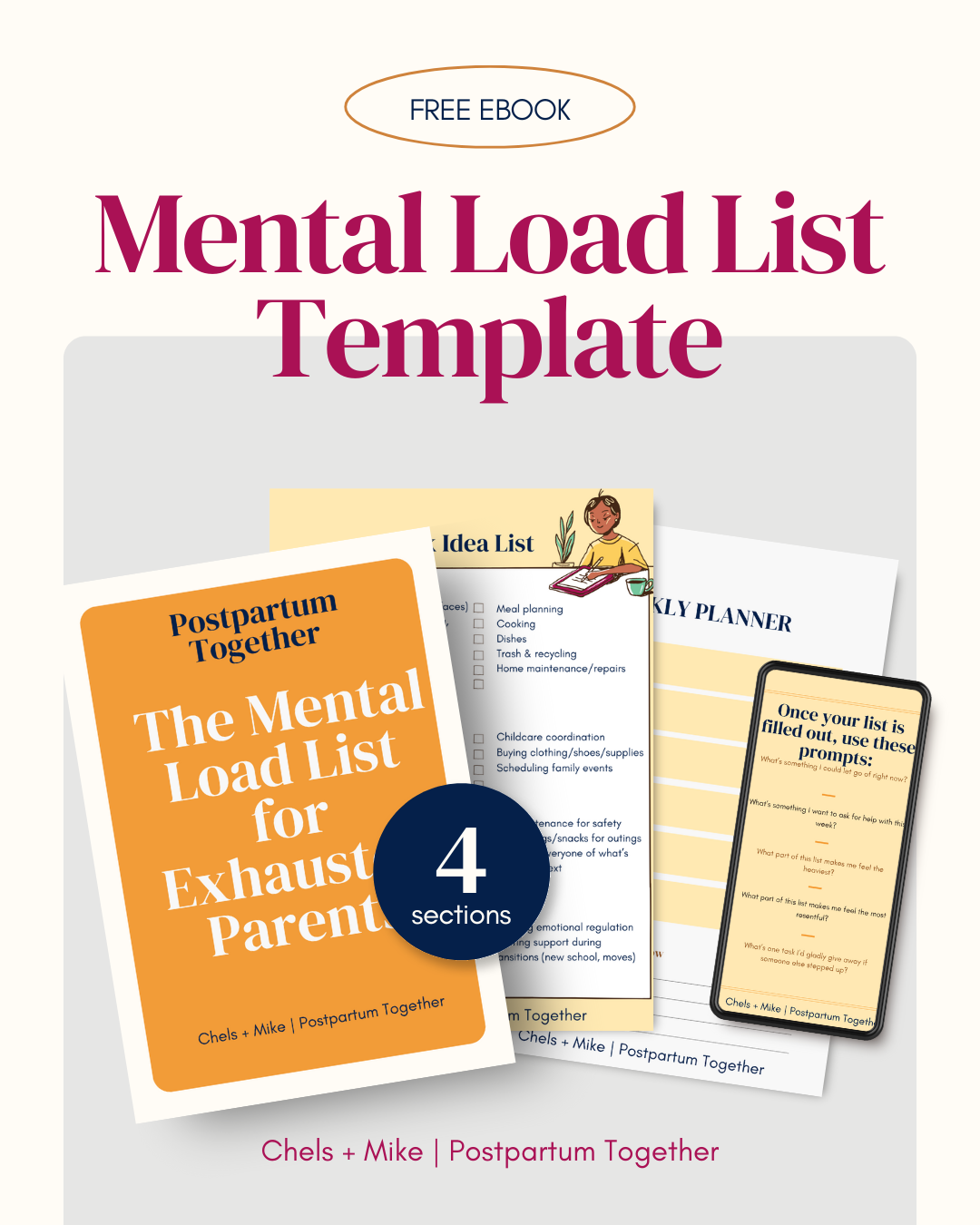
And if you want guided support, our 6-Week Couples Connection Program gives you tools like this so you don’t just survive parenthood—you thrive in it together.
Bottom line: The invisible load doesn’t have to stay invisible. When you see it, say it, and slay it, you stop being scorekeepers and start being true teammates.
