Do You Really Need a Doula? What They Do, What They Cost, and How They Can Support Your Birth Experience
What A Doula Does, What They Cost, and How They Can Support Your Birth Experience
If you're pregnant, especially for the first time, there's a good chance someone has told you to hire a doula.
Maybe your best friend says hiring a doula was the best money she spent during pregnancy.
Maybe you've seen glowing recommendations in Facebook groups or Reddit threads.
Or maybe you've looked at the price and thought:
"I already have a doctor, nurses, and a partner...what exactly am I paying someone else to do?"
It's a fair question.
The truth is, a doula isn't a necessity for every family. Plenty of people have beautiful, supported birth experiences without one.
But for many couples, a doula fills a gap they don't even realize exists until labor has already begun.
Let's talk about what a birth doula actually does, what they don't do, how much they commonly cost, and why I believe they can be one of the most valuable members of your birth team.
What Is a Birth Doula?
A birth doula is a trained, non-medical professional who provides physical, emotional, and informational support before, during, and shortly after childbirth.
A doula is not your medical provider.
They do not:
Deliver your baby
Replace your OB or midwife
Perform cervical exams
Monitor the baby
Diagnose complications
Make medical decisions for you
Instead, they focus on something equally important:
Supporting you.
That distinction matters.
During pregnancy, almost every appointment is centered around the baby's growth and health—as it should be. But pregnancy and birth are also a massive transformation for you.
A doula's role is to care for the person bringing the baby into the world.
More Than Birth: The Meaning Behind Doula Support
One of my favorite things about doulas is that they're part of a much older tradition.
For most of human history, birth wasn't something couples navigated alone in a hospital room.
Women were surrounded by experienced mothers, sisters, grandmothers, neighbors, and community birth attendants. There was often someone bringing water, someone offering reassurance, someone recognizing the rhythm of labor, and someone helping the birthing mother feel calm and supported.
Modern medicine has dramatically improved the safety of childbirth.
But somewhere along the way, many families lost that consistent, non-medical source of support.
Doctors move between patients.
Nurses change shifts.
Your partner loves you deeply—but they may have never witnessed a birth before.
A doula helps restore some of that continuity.
They are the one person whose primary responsibility is simply to stay with you.
What Does a Doula Actually Do During Labor?
Every doula has their own style, but many provide support such as:
Helping you create birth preferences before labor
Explaining evidence-based information
Helping you think through decisions
Offering labor positions
Counter-pressure for back labor
Massage
Breathing reminders
Encouragement
Creating a calm environment
Helping your partner support you
One of the biggest gifts a doula provides isn't physical.
It's emotional regulation.
Birth is deeply physical, but it's also incredibly mental.
Fear creates tension.
Tension can increase pain.
A skilled doula helps create an environment where your body feels safer, calmer, and more able to work with labor rather than against it.
A Doula Helps You Slow Down
Medical providers are experts at helping birth happen safely.
A doula helps you understand how you want to move through that experience.
Labor can move quickly.
Medical terminology flies around the room.
Recommendations are made.
Sometimes decisions truly are urgent.
Sometimes they aren't.
A good doula reminds you that you can ask questions like:
What are the benefits?
What are the risks?
Are there alternatives?
Is this urgent?
Do we have a few minutes to discuss it?
Notice that none of these questions challenge your medical team.
They simply help you participate in your own care.

Do Doulas Improve Birth Outcomes?
Research suggests they can.
The American College of Obstetricians and Gynecologists (ACOG) recognizes continuous labor support—including support from doulas—as beneficial.
Studies have associated continuous labor support with:
Shorter labors
Lower rates of pain medication
Fewer operative births
Greater satisfaction with the birth experience
That doesn't mean hiring a doula guarantees an unmedicated birth, a vaginal delivery, or a perfect experience.
Birth simply doesn't work that way.
The value isn't in guaranteeing an outcome.
It's in helping you feel informed, supported, and cared for no matter how your birth unfolds.
How Much Does a Doula Cost?
Like almost everything in birth, the answer is:
It depends.
Across the United States, birth doulas commonly charge somewhere between $800 and $2,500, depending on:
Location
Experience
Certification
Demand
What's included in their package
Many birth packages include:
One or more prenatal visits
Phone or text support
On-call availability near your due date
Continuous labor support
One or more postpartum visits
Postpartum doulas often charge hourly instead of using one flat package fee.
Some doulas also offer payment plans, sliding-scale pricing, scholarship opportunities, or reduced rates while completing certification requirements.
It's also worth checking whether your HSA, FSA, employer benefits, insurance, or Medicaid program may help cover some of the cost. Coverage varies, but it's becoming increasingly common in many states.
When Is Hiring a Doula Especially Helpful?
While I think many families benefit from doula support, there are certain situations where it can be especially valuable.
You might consider hiring a doula if:
You hope for an unmedicated birth.
You know you'll be getting an epidural.
You feel anxious in medical settings.
You've experienced a previous difficult birth.
You have limited family support.
You want someone experienced helping you navigate labor.
Your partner worries they'll freeze under pressure.
You simply want another calm, knowledgeable person in the room.
One myth I'd love to bust is that doulas are only for "natural birth."
Not true.
A doula can be incredibly helpful during inductions, epidural births, long labors, or cesarean births because support is about far more than pain management.
The Relationship Benefit No One Talks About
This is the part that gets me excited.
Some partners hear the word "doula" and immediately think:
"So...am I being replaced?"
Absolutely not.
A good doula doesn't replace your partner.
They support your partner.
Think about what your partner is trying to do during labor.
They're trying to:
Comfort you
Learn medical information
Remember your birth preferences
Stay calm
Watch someone they love in pain
Make decisions
Advocate
Support your emotions
That's a tremendous amount of pressure.
A doula helps carry some of that weight.
They might quietly show your partner where to apply counter-pressure.
They reassure them that what they're seeing is normal.
They stay with you while your partner grabs food or uses the restroom.
They become a support person for the support person.
Your partner brings intimacy.
Your doula brings experience.
Those two roles work beautifully together.
The Birth Team Is Only as Strong as the Conversations You Have Before Birth
Here's where I think the conversation gets even more important.
A doula can support your birth.
But they cannot build your relationship.
Before labor begins, couples still need to talk about things like:
What does support actually look like?
Do you want constant encouragement or quiet presence?
When do you want your partner to speak up?
How do each of you respond to stress?
Who needs information?
Who becomes overwhelmed?
What helps each of you feel safe?
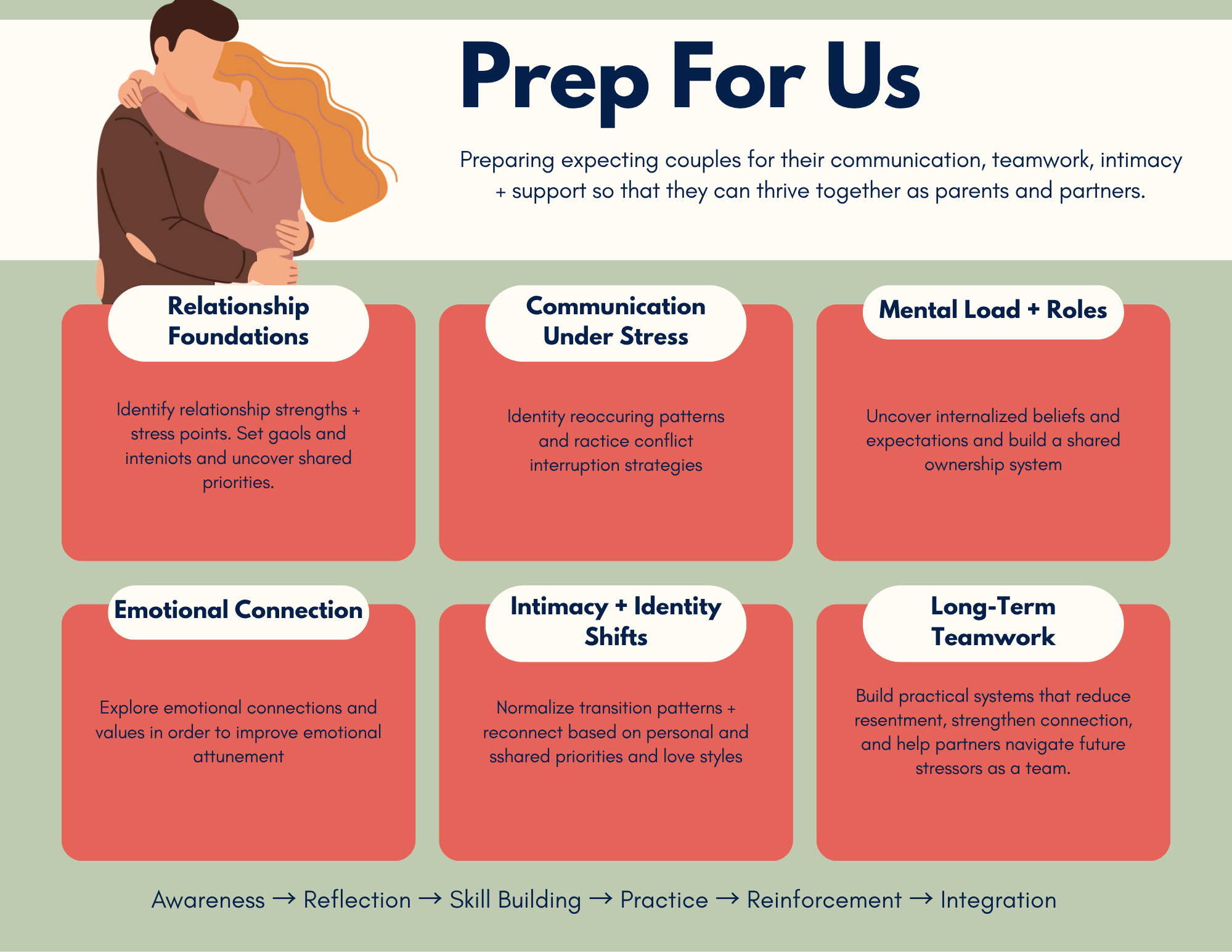
These are exactly the conversations we have inside Prep for Us.
Because a doula can strengthen an already-connected team.
They can't create teamwork in the middle of labor.
How to Find the Right Doula
If you're ready to explore doula support, start by asking:
Your OB or midwife
Childbirth educators
Prenatal yoga instructors
Local parent groups
Trusted friends
You can also search directories like:
DONA International
DoulaMatch
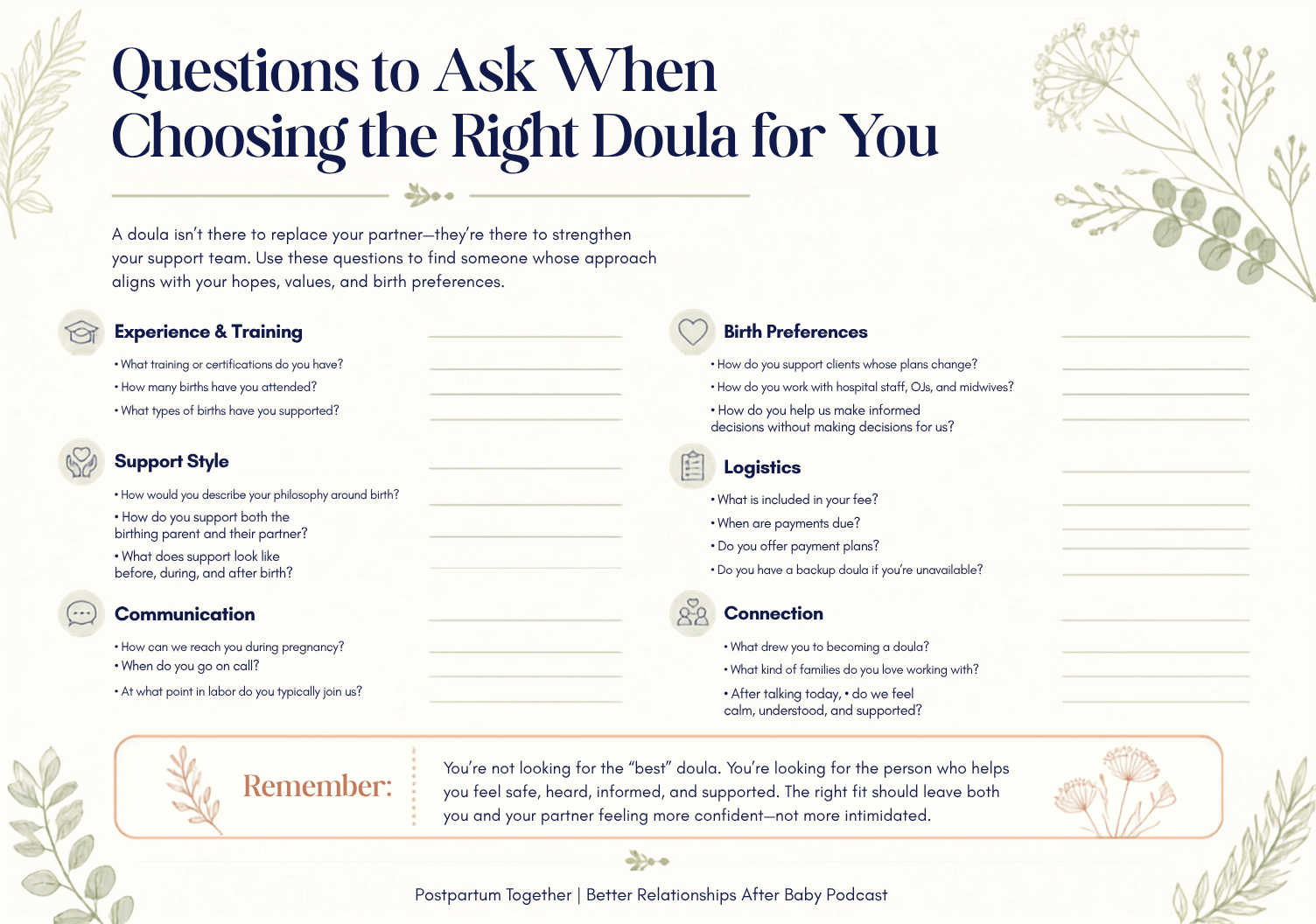
Once you've identified a few candidates, interview at least two or three.
Don't just ask about certifications.
Ask yourself:
How do I feel talking to this person?
Do you feel calmer?
Do they listen?
Do they respect your preferences?
Would your partner feel comfortable asking them questions?
The right doula shouldn't have an agenda for your birth.
They should help you have the birth experience that aligns with your values, your goals, and your medical needs.
Do you need a doula?
No.
You can absolutely have a beautiful birth without one.
But if having experienced, continuous, non-medical support would help you feel calmer, more informed, and more connected to your partner, a doula may be one of the best investments you make during pregnancy.
Birth isn't a test to see whether the two of you can handle everything alone.
It's one of the biggest transitions of your lives.
You deserve support.
Not just for the baby.
For yourselves.
Preparing Beyond Birth
One of the biggest things I see couples miss isn't preparing for labor—it's preparing for life after labor.
You can know exactly how to swaddle a newborn and still have no idea how the two of you will navigate sleep deprivation, decision-making, communication, or the invisible mental load of parenthood.
That's why I created Prep for Us.
Together, we'll help you prepare not only for your baby's arrival but for the relationship transition that comes with becoming parents, so you can enter this new season as partners, teammates, and a family.