Holiday Mental Load Series, Day 1: Home & Hosting Stress — How New Parents Can Share the Load Without Resentment
Why this part of the season hits new parents the hardest—
and how to lighten the load without resentment.
The holidays look different once you’re a parent. No matter how much you love this season, becoming responsible for a tiny human changes how every tradition, gathering, and plan feels. Suddenly, you’re not just thinking about decorations or meals—you’re thinking about nap schedules, overstimulation, guest rooms, noise levels, emotional labor, and the entire rhythm of the day for everyone involved.
And here’s the truth most new parents don’t hear enough:
Hosting isn’t stressful because you’re “doing it wrong.”
It’s stressful because you’re doing it exhausted, with a baby in your arms, while carrying a workload no one else can see.
This is why “home and hosting” hits so many new parents the hardest.
And why today’s blog post is the first in this 10-day Holiday Mental Load Series.
If you feel like you’re quietly holding everything together while your partner wipes down one counter and calls it “helping,” you are so not alone.
Let’s dig in.
Holiday Mental Load Series: Home & Hosting (Day 1)
Why Hosting Feels Like a Lot (Especially With a Baby)
Hosting during the holidays isn’t just tidying up and lighting a candle. Anyone who has ever hosted guests—especially as a new parent—knows that “home and hosting” touches almost every corner of your brain.
Here’s what this category really includes:
Planning meals
Shopping for ingredients
Prepping food
Organizing cookware, serving platters, and fridge space
Decorating and setting the vibe
Rearranging the house to make it feel welcoming
Clearing guest spaces (or your own bed)
Managing piles that have gone untouched during survival-mode parenting
Navigating nap schedules and overstimulation
Anticipating everyone’s needs
Making sure everything is bought, prepped, cleaned, hidden, wrapped, or stored
Research backs this up:
A 2019 study published in Sex Roles found that women perform 3–5x more anticipatory tasks during family gatherings—tasks that no one else sees but everyone benefits from.
In early parenthood, that number quietly multiplies.
This is why so many parents describe hosting as “pressure in every direction.”
And honestly? It’s not your fault. It’s not your partner’s fault.
It’s the invisibility of the workload.
When you’re the one holding 10 categories of planning in your head, even the world’s most empathetic partner can miss how much is happening under the surface.
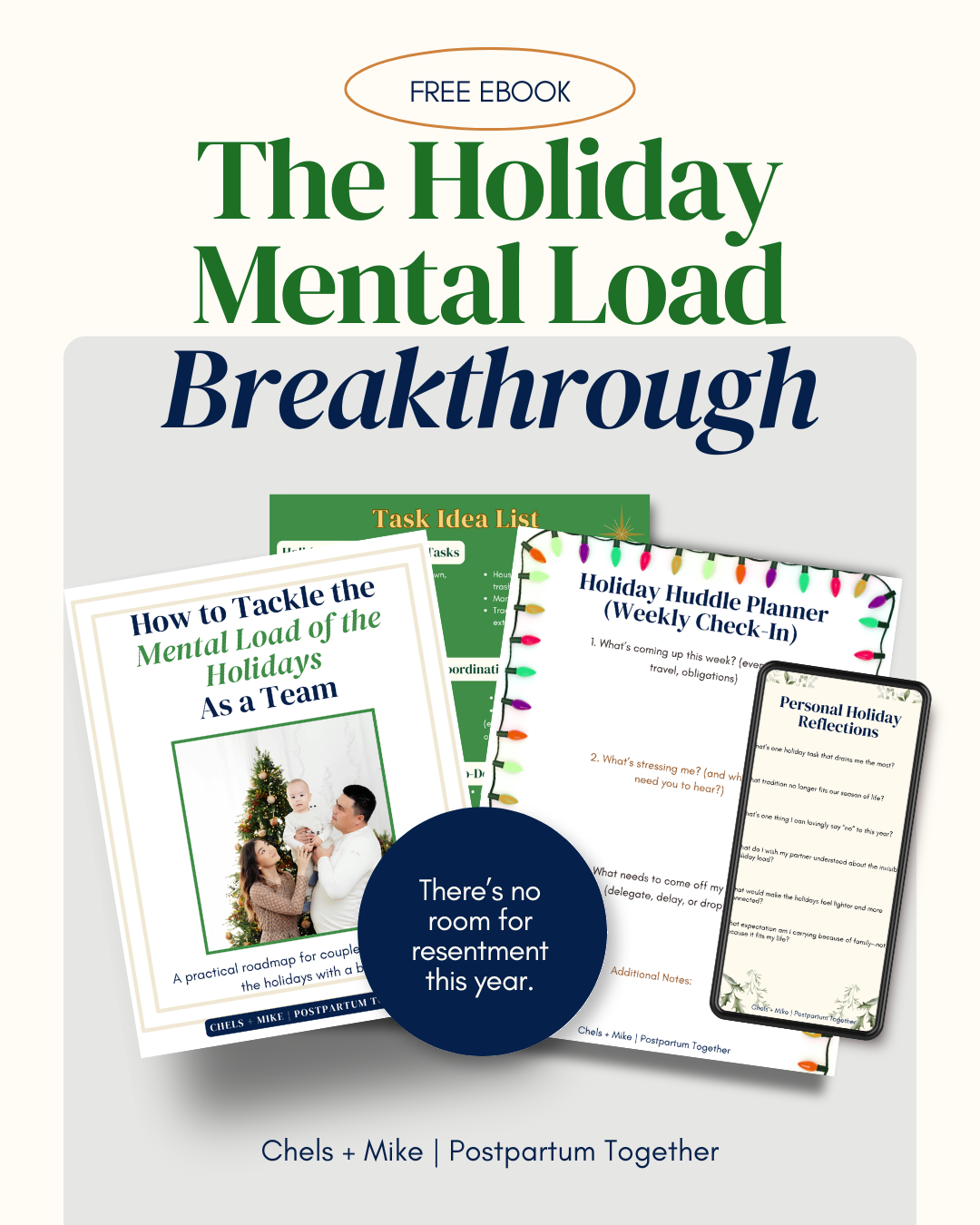
Click image for instant download! (No email required)
Why One Parent Ends Up Carrying Most of It
Most couples don’t sit down and decide who will become the holiday coordinator.
It just happens.
A few reasons why:
One person has been keeping track of baby needs all year, so people default to them.
Tiny, unspoken habits compound over time.
The mental load naturally migrates to whoever anticipates needs first.
Partners often misread “tasks done” as “load lightened.”
Both people assume they have the same standards for hosting—when they don’t.
The result?
One parent is swimming in a sea of invisible work,
and the other thinks they’re helping by wiping down a single counter.
It’s the mental load creeping in quietly.
A Simple Tool to Reset the Dynamic: The “Good Enough Holiday Home Agreement”
Here’s the practical tool Mike and I want you to take into this holiday season. It’s simple, but game-changing:
Step 1: Sit down and name what actually matters. Together.
Ask yourselves:
Does the bathroom need to be spotless?
Do we want a cozy vibe?
Does lighting matter to us?
Is food presentation a priority?
Do we care about décor this year?
Is it important that gifts are wrapped beautifully or just wrapped?
What level of “clean” is good enough for us in this season of life?
Do not assume you share the same standards.
This right here is where 60% of holiday resentment grows—unspoken expectations.
Step 2: Sort everything into three buckets.
Must Do
These are your non-negotiables. The essential things for the holiday to function or feel good.Would Be Nice
The “bonus round” category. Only happens if there is time, energy, or help.Not This Year
These are the traditions, ideas, or tasks that will return in a future season—but not this one.
Research from the American Psychological Association shows that couples who intentionally lower seasonal expectations experience significantly lower holiday conflict and higher relationship satisfaction.
Translation:
You don’t need to be superhuman.
You need to be aligned.
Step 3: Divide the “Must Do” list fairly.
Fair doesn’t always mean equal.
Fair means:
Clear
Transparent
Based on bandwidth
Aligned with reality (not fantasy expectations)
Supportive of both partners, not just one
Once you’ve sorted the list, dividing it will feel doable instead of overwhelming.
Why This Step Matters for Your Nervous System
This isn’t just about chores.
This is about capacity, connection, and your body’s stress response.
When you’re keeping 50 invisible tabs open in your mind, your nervous system stays in a low-grade activation state. That affects:
Patience
Sleep
Memory
Creativity
Sex drive
Capacity to co-regulate with your baby
Your ability to feel connected to your partner
When you lower the load, you lower the activation.
And when you lower the activation, the season starts to feel like… the season again.
You deserve to feel warm, not chaotic.
Connected, not resentful.
Supported, not stretched thin.
How to Make This Conversation Easier
If starting this talk feels intimidating, there’s a reason.
Research on household labor shows that most couples avoid conversations about division of work because they know it can spark conflict—but avoiding the conversation guarantees more conflict later.
That’s why we built the Holiday Mental Load Breakthrough.
Inside the home & hosting section, you’ll find:
Prompts
Categories
Conversation starters
Lists you can fill in together
Scripts for making the invisible visible
A built-in “brain dump” process
All you need is 10 minutes.
No guessing.
No nagging.
No resentment.
Just clarity.
Your Next Step: Make the Invisible Load Visible
You don’t have to be the default holiday planner.
Unless you genuinely love it.
And even then—you shouldn’t have to do it alone.
This season can feel lighter.
You can feel like a team again.
And it all starts here:
👉 Download the Holiday Mental Load Breakthrough
Sit down with your partner for 10 minutes.
Do the brain dump.
Sort your buckets.
Agree on what matters and what doesn’t.
This is the beginning of steadiness.
This is where pressure shifts into partnership.
This is where the season starts to feel warm again.
Click image for instant download.
