Holiday Mental Load Series: Day 2 — Family Logistics & Coordination Stress
If Day 1 was all about home and hosting, Day 2 dives into the category that quietly drains almost every couple: holiday logistics and family coordination.
This is the category that turns even the super-organized, spreadsheet-loving, type-A parent into a puddle of overwhelm by December 10th.
And honestly? It sneaks up on people.
Because none of the individual decisions seem that big.
But when you add them together, the list gets loud.
Today’s post breaks down:
Why logistics hit new parents harder
Why one partner usually ends up carrying it all
The research behind this invisible load
The #1 tool to protect your relationship during holiday planning
Scripts + prompts to make this easier
How to divide the work fairly (without fighting about it)
Let’s get into it.
The Logistics Category No One Warns You About
Holiday logistics are the “in between” pieces of the season.
The connecting tissue.
The things that aren’t technically hosting… but are essential for everything to run.
Here’s what logistics really include:
Travel plans
Nap schedules
Drive times
Packing lists
Gift exchanges
RSVPs
Drop-off and pick-up windows
Communication with extended family
Food contributions
“Which side do we visit first?”
Overnight plans
Weather issues
Feeding times and pumping schedules
“Do we bring the sound machine?” debates
Coordinating pets or house-sitters
Backup clothes for the baby
Backup clothes for the adults
“How long do we stay?”
None of these tasks look intense on their own.
But when stacked?
They become a full-time job—on top of actual full-time jobs and full-time parenting.
A 2021 Journal of Family Psychology study found that “coordination labor” is the #1 invisible category that predicts resentment in couples with young children.
Not decorating.
Not gift-buying.
Not childcare.
Coordination.
Because it requires:
anticipating
planning
adjusting
tracking details
negotiating needs
remembering everything
keeping the timeline together
And if you are holding the entire December operations calendar in your head, it is no wonder the pressure gets heavy fast.
Why One Parent Usually Ends Up Carrying It
Most partners don’t sit down and divide the holiday load like a project team.
It just… happens.
Here’s why:
1. Default parenting bleeds into default coordinating.
If you are the parent handling baby naps, feeding windows, or overstimulation cues, holiday logistics quietly fall to you too.
Not on purpose.
Just momentum.
2. One of you anticipates faster.
Anticipating needs is a skill—one rooted in upbringing, gender norms, and practice.
Whoever anticipates first becomes the “logistics manager.”
3. The other partner truly doesn’t see the full picture.
If your partner says, “Just tell me what to do,” it’s not usually because they don’t care.
It’s because they can only see the one thing directly in front of them… while you’re holding 17 variables in your head.
4. Logistics are invisible until they fall apart.
No one applauds the person who planned the drive time perfectly.
But everyone notices if you show up late.
Invisible labor is only visible when it fails.
This is why this category triggers so many holiday fights.
The Emotional Layer No One Talks About
Holiday logistics are not just logistics.
They bump into:
old family expectations
childhood patterns
cultural norms
pressure to “make the rounds”
fear of disappointing someone
fear of being judged
guilt
feeling torn between sides
not wanting to hurt anyone’s feelings
choosing between two families you love
You feel it.
Your partner feels it.
And the weight doubles when you add a newborn, sleep deprivation, or postpartum recovery on top.
The Silent Script Behind Most Holiday Fights
After coaching hundreds of couples, I can tell you the underlying tension is NOT:
“Who’s driving?”
“Whose family do we see first?”
“Why is the diaper bag not packed?”
The actual script running in most new parents’ heads looks more like:
“I feel like I’m holding everything together.”
“I can’t be the glue for everyone.”
“I’m overwhelmed and no one seems to notice.”
“I need help but I don’t want to nag.”
“If I don’t hold it all, it will fall apart.”
“I love my partner, but why am I doing all the thinking?”
And when someone feels unseen or unsupported, even small logistical decisions spark bigger arguments.
Not because you’re dramatic.
Because you’re overloaded.
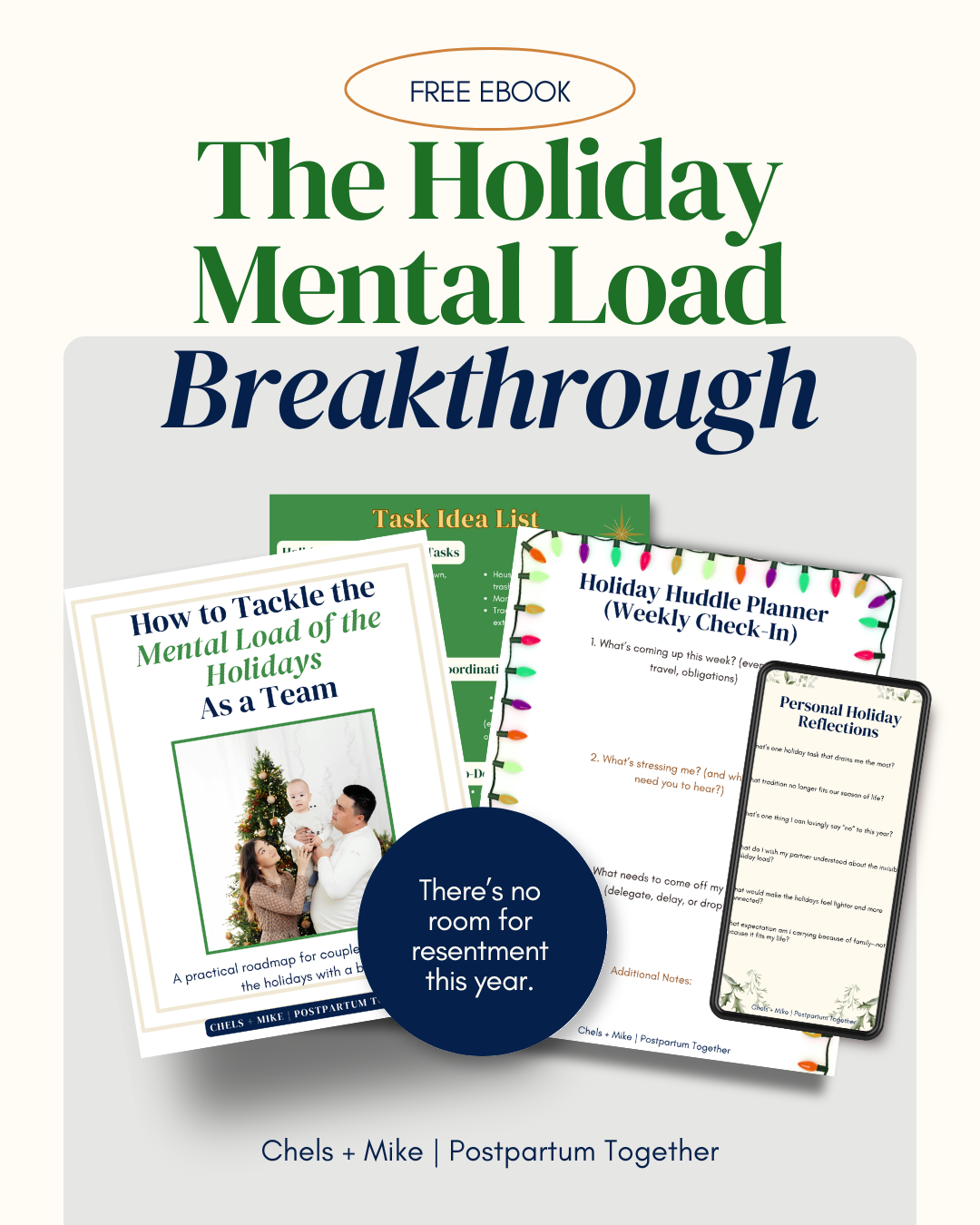
The Tool That Makes This Category Manageable: The Holiday Huddle
This is the tool Mike and I teach inside the Holiday Mental Load Breakthrough.
It’s simple.
It takes 10 minutes.
And it prevents 85% of the logistical fights couples report around the holidays.
The Holiday Huddle
A weekly 10-minute meeting where the two of you…
Look at the upcoming week’s logistics
travel
meals
naps
events
work schedules
childcare
family expectations
Decide what actually matters
(one of the core questions that lowers tension)Name who is leading what
Not “who is doing a task,” but who is leading a category.
The mental load sits with the leader.Note anything that feels heavy so you can support each other
That’s it.
Ten minutes.
Once a week.
And suddenly December is not a guessing game.
It’s a shared plan.
Why the Holiday Huddle Works (The Psychology)
Studies from the Gottman Institute show that couples who build weekly planning rituals see:
lower conflict
higher communication clarity
fewer surprise stress spikes
more teamwork
less resentment
better emotional connection
Because planning is not just planning.
It’s emotional safety.
It’s co-leadership.
It’s both partners knowing what’s ahead.
And that matters even more in early parenthood, when your bandwidth is limited and your margin for chaos is small.
Scripts to Start the Conversation (So It Doesn’t Get Awkward)
Option 1: Gentle, honest, vulnerable
“Hey, there’s so much happening this month and I’m carrying a lot of the moving parts. Can we sit down for 10 minutes and map out this week together?”
Option 2: Team-based
“I want us to feel like partners, not like one of us is guessing. Want to do a Holiday Huddle this week so we can divide things clearly?”
Option 3: For the partner who doesn’t lead logistics
“I want to show up better for you this month. Can we do a quick weekly huddle so I can see what’s on your plate and take the lead on some categories?”
Option 4: For the stress-avoidant partner
“I know December feels overwhelming. This actually makes things calmer because it prevents last-minute decisions. Want to try it for 10 minutes?”
These work because they avoid blame and focus on clarity.
Why a Weekly Logistics Check-In Prevents Holiday Blow-Ups
Here’s the pattern we see with couples:
Logistics build quietly.
One partner feels overloaded.
They don’t say anything because they don’t want to start a fight.
A small change (a text from a family member, a missed nap, a late arrival) becomes the tipping point.
A bigger argument erupts—often not about the real issue.
But when logistics are visible?
There’s no surprise.
There’s no “How did I get stuck with this?”
There’s no “Why didn’t you tell me?”
There’s no “I’m drowning while you wrap one present.”
Visibility reduces tension.
Clarity reduces resentment.
Shared leadership reduces overwhelm.
How to Divide Logistics Fairly This Year
Fair does NOT mean 50/50.
Fair means:
realistic
based on capacity
grounded in strengths
not rooted in guilt or tradition
Here’s the formula:
1. One person leads the category.
Leadership = mental load.
Execution can be shared.
2. The leader sets the standard.
Because you can’t lead what you can’t control.
3. The partner is responsible for supporting the leader.
AKA “You’re the pilot, I’m the co-pilot.”
4. Switch categories if you hit capacity.
Capacity-based division prevents resentment.
5. Revisit weekly.
Things change fast with a baby—it’s okay to adjust.
This structure keeps both partners anchored in teamwork instead of tension.
Your Day 2 Takeaway
Make a plan before the plan becomes the problem.
You do not need to do December on “hard mode.”
No gold star exists for the most stressed-out new parents.
There is no prize for carrying the entire mental load alone.
You deserve clarity.
You deserve support.
You deserve a holiday that does not require a full emotional recovery afterward.
And the first step is simple:
Download the Holiday Mental Load Breakthrough
It walks you through:
A full logistics rundown
Travel timing
Family communication
Emotional triggers
Category leadership
Step-by-step brain dump
Scripts for hard conversations
Do this together.
Ten minutes.
One page of clarity.
And the season starts to feel lighter.
You don’t need to live in December overwhelm.
You can feel calm, connected, and on the same page.
This is where it begins.
