Holiday Mental Load Series: Day 3 — Event Schedules & Seasonal To-Dos
If you’ve ever looked at your December calendar and felt your stomach flip, you’re not alone.
There’s a specific part of the holiday season that pushes even the most patient parent to the brink:
Event schedules and the endless seasonal to-dos.
This is the category where December stops feeling like a month and starts feeling like a conveyor belt of, “Where do we have to be next?”
The parties.
The outings.
The Santa visits.
The school programs.
The neighborhood events that were “super low-key” but somehow took three hours.
This is the part of the season where even the most organized couples feel themselves slipping into overwhelm. Not because they don’t want to enjoy the holidays—of course, they do—but because the mental to-do list around events is massive.
And for new parents?
It multiplies.
Why Events Hit Different When You Have a Baby
Attending a holiday event used to be simple: pick a time, get dressed, bring something festive, done.
Add a baby, and suddenly every event comes with a checklist:
When will they nap?
Will they melt down?
Will they fall asleep in the car and ruin bedtime?
Do we pack food?
Do we pack backup food?
Does the outfit need layers?
How cold is it?
Do we need a stroller? A carrier? Both?
What if the weather changes?
How long can we realistically stay?
Will this knock us off rhythm for two days?
These questions alone are enough to mentally drain a parent before they’ve even buckled the car seat.
Research from Infant Behavior and Development shows that babies experience sensory overload faster in unfamiliar environments, which means new parents are constantly scanning:
noise, light, temperature, stimulation, timing, and energy.
You’re not “overreacting.”
Your brain is literally doing high-level risk assessment while everyone else is sipping mulled wine.
Why One Parent Usually Ends Up Carrying All of It
Event planning comes with an invisible cognitive load, and one partner—usually the one who has been managing the baby’s needs day to day—accidentally becomes the keeper of all the details.
Here’s how it happens:
1. You’re already the rhythm-holder.
If you’re the one usually tracking naps, feeding windows, or sensory needs, you naturally track event impact too.
2. You anticipate faster.
Whoever anticipates first usually becomes the “event manager.”
3. Your partner truly doesn’t see the full picture.
They see:
“What time do we need to be there?”
You see:
“What time do we need to leave + how long it takes to load the car + whether we’ve packed everything + how overstimulating this might be + what meltdown window we’re landing in.”
4. The consequences of missing a detail are big.
Forgot the diaper bag?
Forgot snacks?
Forgot the pacifier?
Forgot the stroller?
The fallout lands on the parent already doing the most mental juggling.
Invisible work stays invisible until something goes wrong.
And new parents feel the weight of that deeply.
The Hidden Pressure of Seasonal To-Dos
Events don’t show up alone. They come with a chain reaction of extras:
baking
decorating
gift exchanges
childcare coordination
photo-taking
present wrapping
class parties
neighbor gifts
church or community events
costume/outfit prep
donation drives
“traditions” we somehow feel obligated to keep
And then there’s guilt.
A lot of it.
Guilt about:
skipping an event
disappointing someone
doing less than previous years
not recreating your childhood traditions
not giving your kids “the magic”
But here’s the truth:
Half the things families stress about in December aren’t things they actually want to do.
They’re things they’ve been conditioned to think they should do.
Traditions are only meaningful if they fit the season of life you’re in—not the one you imagine you “should” be able to handle.
A Tool That Cuts 30–50% of Your To-Dos Instantly
We use this tool with couples inside our coaching programs all year, and it becomes even more powerful in December.
Call Out the “Memory Pressure.”
Look at your event list with your partner and ask:
“What memories are we actually trying to make?”
And then:
“What memories are we performing for someone else?”
This question alone removes:
guilt
obligation
social pressure
comparison energy
perfectionism
It also clarifies something couples forget:
You do not need to do everything to have a meaningful holiday season.
You need presence.
You need connection.
You need space for joy—not pressure.
And most families don’t have space because they’re overscheduled.
Why Mapping It Out Lowers Stress Immediately
Your brain relaxes when tasks become visible.
A study in Applied Cognitive Psychology found that people experience a measurable drop in stress when they externalize cognitive load onto a physical list.
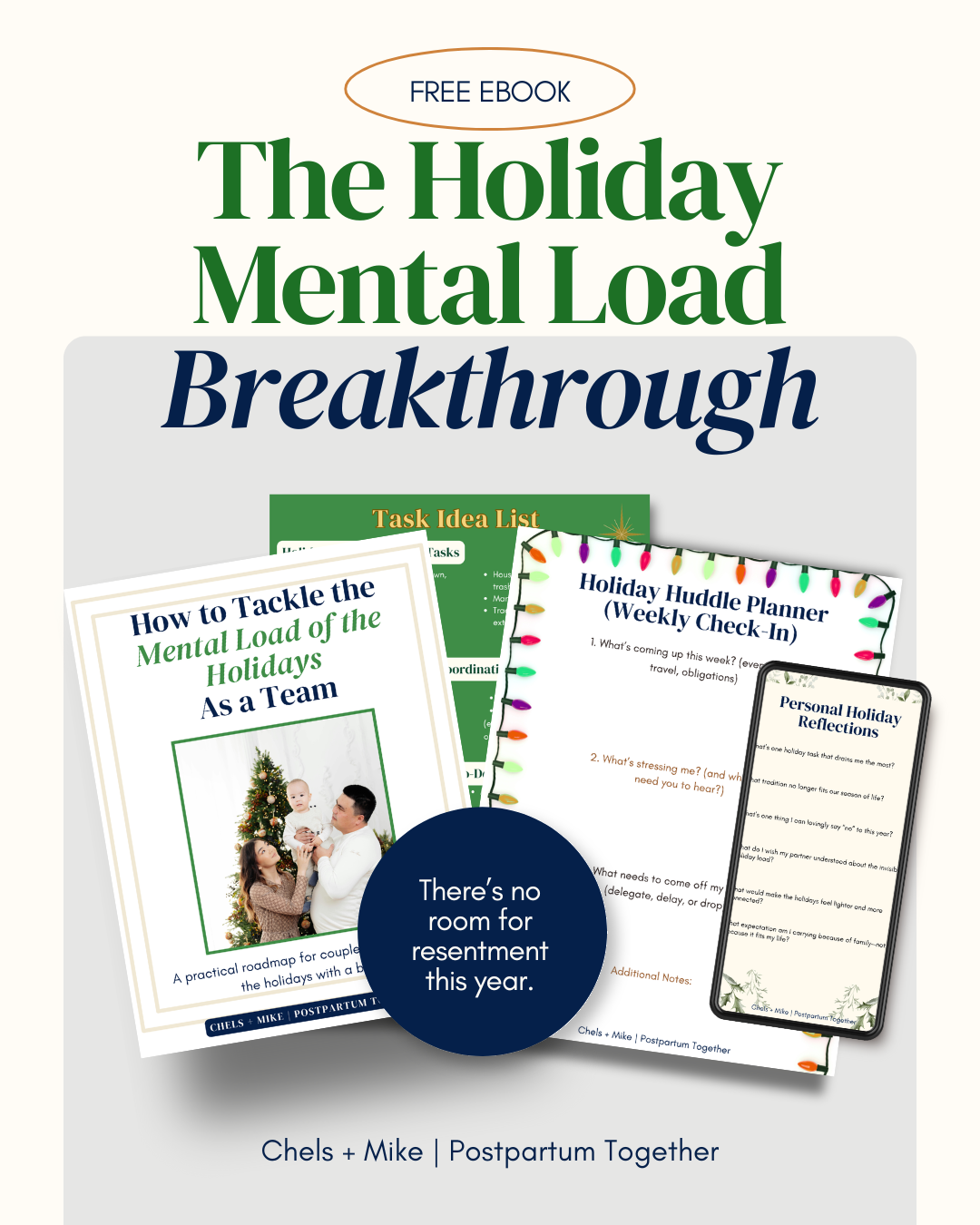
This is why we dedicated such a large section of the Holiday Mental Load Breakthrough to:
seasonal to-dos
event dates
priority sorting
lead vs support roles
deleting tasks
delegating tasks
capacity-based decisions
When you can see it, you can evaluate it.
When you can evaluate it, you can choose consciously.
When you choose consciously, your stress drops.
The Weekly Tool That Saves You from Burnout
The Weekly Holiday Huddle
Ten minutes.
One conversation.
Every week.
You sit down together and review:
what’s coming up
what you actually have capacity for
what you want to delete
who is leading what
what support is needed
This works because the tension around events isn’t about events.
It’s about:
unclear expectations
overcommitment
one-sided preparation
feeling rushed
feeling unsupported
hitting emotional limits
old family norms that no longer fit your life
When you plan together—even if the week is still busy—you’re not scrambling.
You’re aligned.
And alignment dramatically lowers holiday conflict.
Why Over-Scheduling Breaks Couples More Than They Expect
Here’s the pattern we see in couples every year:
The calendar fills without conversation.
One partner is carrying 90% of the event prep.
Everything gets rushed.
The baby melts down.
The adults start snapping.
A tiny miscommunication turns into a bigger argument.
You both wonder why you’re fighting when this was supposed to be fun.
But the real issue isn’t the event.
It’s the invisible load behind the event.
When you remove the invisible part, the resentment loses its fuel.
What It Looks Like When Couples Share the Event Load
Couples report:
fewer arguments in the car
smoother transitions
clearer expectations
less sensory overwhelm
more consistent rhythms
more room for fun
fewer meltdowns—for adults and babies
more connection during the event
less recovery time after
Sharing the emotional and logistical labor of December doesn’t just prevent burnout.
It makes joy possible again.
Your Takeaway for Day 3
Don’t let the calendar run your family.
Your family values should run the calendar.
When you choose what matters, the rest becomes optional.
When you delete what doesn’t fit, you make room for rest.
When you divide the load, the season becomes enjoyable again.
You deserve a December that feels connected—not chaotic.
Warm—not rushed.
Shared—not carried by one person.
If you haven’t yet, download the Holiday Mental Load Breakthrough.
Inside, you’ll find:
the full seasonal to-dos breakdown
event planning templates
lead/support role tools
deletion + delegation guidance
conversation starters
weekly Holiday Huddle structure
Use it to map out your events, delete what drains you, and divide the load so neither of you is drowning in invisible work.
This is how you reclaim your season.
