Can You Prevent Postpartum Depression? Protective Factors Couples Can Build During Pregnancy
Pregnancy has a strange way of making the future feel both incredibly close and impossibly far away.
You are picking out baby gear. Thinking about names. Feeling kicks. Scheduling appointments. Trying to imagine what this person will look like when they are finally in your arms.
And then something happens in the news that makes postpartum feel much less abstract.
The Lindsay Clancy trial has brought maternal mental health back into the national conversation. Hayden Panettiere’s years of speaking publicly about postpartum depression have also given many women language for experiences that can otherwise feel incredibly isolating.
These stories are different. Their diagnoses, circumstances, and outcomes should not be lumped together.
But they can leave an expecting parent sitting with an uncomfortable question:
What if I am not okay after my baby is born?
That is a difficult question to ask during a season that is supposed to be full of anticipation.
It is also a very important one.
Before we go any further, I want to be clear about the scope of this conversation.
I am not a mental health clinician. Postpartum depression is a medical condition, and there is no checklist that can guarantee someone will or will not experience it. Postpartum depression and postpartum psychosis are also distinct conditions and should not be treated as interchangeable.
What we can talk about are protective factors.
We can talk about the systems, relationships, conversations, and support structures couples can begin creating during pregnancy so that a new mother is not left carrying everything alone.
And that kind of preparation matters.
Postpartum Mental Health Preparation Starts Before Birth
One of the biggest mistakes we make in pregnancy is treating postpartum mental health as something we will deal with if it becomes a problem.
We prepare for birth.
We take infant CPR.
We build registries.
We tour hospitals.
We install car seats.
But many families do not create any kind of plan for what happens if the mother begins feeling emotionally, mentally, or physically unlike herself.
That means the first real conversation about mental health may happen when everyone is already sleep-deprived, overwhelmed, and scared.
A better approach is to begin during pregnancy.
Not because you are expecting something to go wrong.
Because you are making it easier to respond if something does.

The first step is simply knowing your own history.
That may include talking with your provider about previous depression or anxiety, significant trauma, current stress, relationship strain, financial stress, or limited social support.
You do not need to wait until a postpartum appointment to introduce your mental health history.
Pregnancy is a reasonable time to ask:
Have I experienced anxiety or depression before?
What tends to happen to me during periods of extreme stress?
How does sleep deprivation affect me?
Who currently knows my mental health history?
What professional support could I establish before birth?
For some people, that may mean finding a therapist who specializes in perinatal mental health during pregnancy instead of waiting until postpartum feels unmanageable.
In the podcast episode accompanying this article, I recommend starting with Postpartum Support International when looking for a provider with specific perinatal mental health training.
Postpartum Support International Provider Directory
Build the Mental Health Team Before You Need It
Your partner should know how to support you.
Your partner should not have to become your entire mental health care system.
That distinction is important.
One person cannot simultaneously be your spouse, co-parent, sleep support, medical professional, therapist, household manager, and emergency plan.
Instead, think about building a small circle of people and professionals who each serve a different role.
That might include:
Your OB or midwife
A primary care provider
A perinatal mental health therapist
A psychiatrist, if appropriate
Lactation support
A trusted friend or family member
Your partner
Then make the information accessible.
Who is the primary medical contact?
Where is the therapist’s phone number?
Who could come over if both parents are depleted?
Who knows enough about you to recognize that something feels different?
Who can help with feeding concerns before they become a major source of stress?
These are exactly the kinds of things you want written down before anyone is trying to find them at 2 a.m. after several nights of fragmented sleep.
I created a Postpartum Plan specifically to help couples organize some of this information before the baby arrives.
Protect Sleep Like It Matters
Newborn sleep is unpredictable.
I am not going to tell you that the answer to postpartum mental health is getting eight uninterrupted hours every night.
That would be neither realistic nor helpful.
But we do need to stop creating postpartum plans where one person’s sleep is automatically expendable.
Sleep protection may look like:
Creating shifts when possible
Letting one parent settle the baby after a feed
Protecting an early-morning sleep block
Asking family or friends to help after especially difficult nights
Creating opportunities for daytime rest
Adjusting the plan when one person is clearly no longer functioning well
The important part is that sleep is treated as a shared health concern.
Not a luxury one parent earns after everyone else’s needs are met.
And partners, this is where noticing matters.
Do not wait until she is completely depleted and begging for rest before stepping in.
Sometimes support looks like recognizing the need before she has to turn it into another request she is responsible for making.
If you want to go deeper into this piece, I also have an entire article on newborn night shifts and how couples can divide overnight care.
Newborn Night Shifts: How Should Couples Split Overnight Care?
Remove the Default-Parent Assumption Before It Exists
This is one of the most important conversations couples can have during pregnancy.
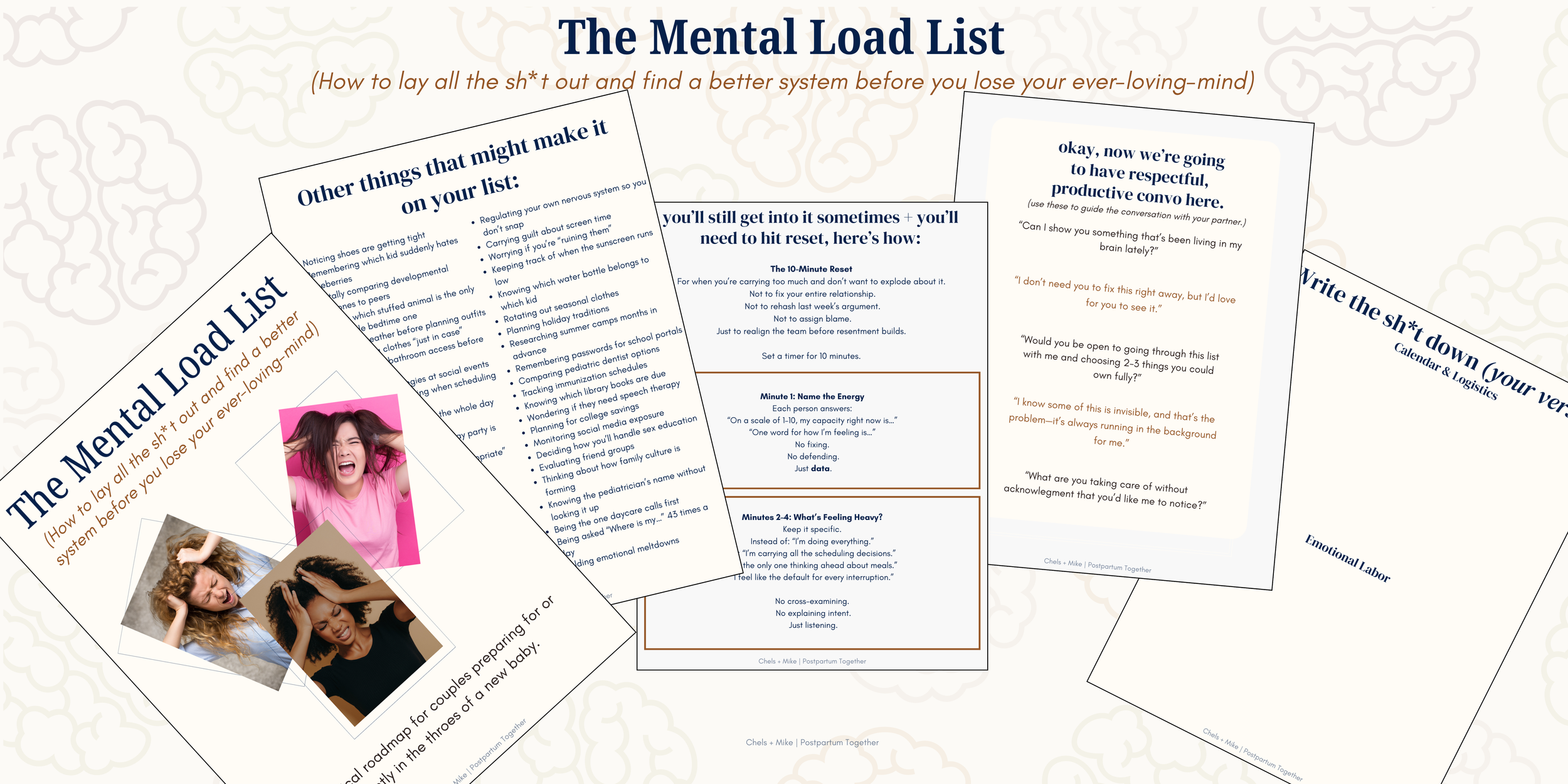
Who will become the person who remembers everything?
Who knows when diapers are running low?
Who schedules the pediatrician?
Who keeps track of feeding concerns?
Who washes pump parts?
Who responds to family messages?
Who notices the baby has outgrown the current size of clothes?
Who realizes there is no food in the house?
In many families, the answer slowly becomes:
Mom.
Not necessarily because anyone decided that.
It simply happens.
One parent begins noticing, researching, remembering, and directing.
The other parent may genuinely want to help—but still waits to be told what needs to happen.
And that means the mental tabs never close.
This is why I often tell couples:
Support is not only saying, “Tell me what you need.”
Support is developing enough awareness that one partner does not have to manage the other person’s participation.
This is not because doing the dishes prevents postpartum depression.
It does not.
It is because chronic overload, isolation, and feeling unsupported are not conditions we should knowingly create around someone recovering from birth.
Before the baby arrives, talk about ownership.
What can each partner fully own?
Not “help with.”
Own.
That might mean one person owns:
Grocery inventory and ordering
Pump-part cleaning
Meal coordination
Family updates
Pediatrician scheduling
Overnight diaper changes
Visitor communication
Household laundry
The exact division is less important than creating a shared understanding before resentment has a chance to build.
Ask Better Questions Than “How Are You?”
“How are you?”
“Fine.”
That exchange can happen for weeks while someone is quietly falling apart.
Many women are extremely practiced at functioning.
They continue feeding the baby.
Answering texts.
Keeping appointments.
Remembering what everyone needs.
Smiling at visitors.
Looking capable.
Functioning does not necessarily mean being well.
That is why partners, friends, and family members may need to ask more specific questions.
Instead of only:
“How are you?”
Try:
“Do you feel like yourself today?”
“What feels harder than it did last week?”
“Are you getting moments where you actually feel okay?”
“Are you having thoughts that feel unusual or scary to you?”
“Do you feel safe being alone right now?”
“Do you want me to listen, take something off your plate, or help you contact someone?”
And if someone says:
“I don’t feel like myself.”
Do not immediately explain it away.
Do not rush to:
“You’re just tired.”
“You’re hormonal.”
“Everyone feels overwhelmed.”
Get curious.
Take the statement seriously.
Help connect them with someone who is qualified to evaluate what is happening.
Create the Safety Plan Before Anyone Needs It
Some of the most valuable conversations during pregnancy are not particularly fun.
This is one of them.
What happens if postpartum is not going well?
You can think of your plan in layers.
Something feels off
Maybe the mother is more overwhelmed, disconnected, anxious, or depleted than usual.
At this point, support may look like reducing the load, protecting rest, listening, and checking in again.
Symptoms are persisting or getting worse
This is when the plan moves beyond “let’s see how tomorrow feels.”
Contact the OB, midwife, therapist, or another appropriate professional.
Partners can be extremely helpful here.
Not by diagnosing.
By making the call easier.
By offering to attend the appointment.
By staying with the baby if the mother wants to meet privately with her provider.
By helping her get to the person who can assess what is happening.
Someone is not functioning safely
This is where you want the plan to be especially clear.
What happens if the mother says she does not feel safe?
What if she reports thoughts of harming herself or the baby?
What if she appears confused, detached from reality, paranoid, or dramatically unlike herself?
Those situations should not depend on the struggling person having enough clarity and energy to build a response plan in that moment.
Have the conversation during pregnancy:
If I tell you that I do not feel safe, what will we do?
Know who gets contacted.
Know who takes the baby.
Know where you would go for urgent care.
Know that neither partner will minimize it or keep it secret to protect appearances.
If you are in immediate danger or concerned that someone may harm themselves or another person, seek emergency medical care immediately.

Partners: You Do Not Have to Fix Her
I especially want partners to hear this.
You are not responsible for preventing every mental health condition.
You do not need to diagnose postpartum depression.
You do not need to become a therapist.
You do not need to have all the answers.
Your job is not to “fix” her.
But you can take more responsibility for the environment around her.
You can:
Protect opportunities for sleep
Bring food and water without waiting to be asked
Fully own household responsibilities
Manage your family and visitors
Learn basic warning signs yourself
Know the names and contact information of her providers
Attend appointments if she wants you there
Notice meaningful changes
Ask direct questions
Believe her when she says something feels wrong
Make the call when she does not have the capacity to do it herself
And perhaps most importantly:
Continue treating her like a whole human being.
Not only the baby's food source.
Not only the default parent.
Not only the person who knows where everything is.
See her.
Talk to her.
Notice her.
One of the most important points I made in this episode is that we should not confuse functioning with wellness.
A woman can feed the baby, attend appointments, answer texts, manage the household, and look completely capable while struggling tremendously inside.
Postpartum Depression Prevention Is Not About Creating a Perfect Environment
None of this guarantees that postpartum depression will not happen.
That is not the promise.
A supportive partner cannot “love someone out of” a medical condition.
A chore chart cannot treat depression.
Sleeping in shifts is not therapy.
A postpartum plan is not a substitute for professional care.
What these things can do is create stronger relational and practical structures around a new family.
They can make it easier to notice change.
Easier to speak up.
Easier to rest.
Easier to access help.
Easier to recognize that the mother deserves care too.
That distinction is central to the work I do.

How Prep for Us Fits Into Postpartum Mental Health Preparation
Prep for Us is not postpartum depression treatment.
I am not a mental health clinician.
What I help couples build are some of the relational structures that can make postpartum feel less isolating and less dependent on one person holding everything together.
Inside Prep for Us, couples work on:
Understanding one another’s stress responses
Sharing the mental load
Clarifying roles and expectations
Asking for help earlier
Protecting postpartum recovery
Identifying outside support
Communicating when something is not working
Creating systems that can adapt when real life looks different from the plan
The goal is not perfection.
The goal is not guaranteeing that postpartum will be easy.
The goal is to make sure the two people becoming parents know how to recognize each other, communicate, adjust, and get support when needed.
Because we cannot guarantee that a mother will never experience postpartum depression.
But we absolutely can stop pretending that our best postpartum mental health strategy is handing her a baby and hoping she tells everyone if she starts drowning.
Keep Reading
If you want to understand the broader spectrum of postpartum mental health conditions—including postpartum depression, postpartum anxiety, intrusive thoughts, and postpartum psychosis—read:
Women Share Their PMAD Stories
If you are expecting and want to create your practical postpartum support system now:
And if you want the two of you to prepare together for the relationship transition into parenthood:
